

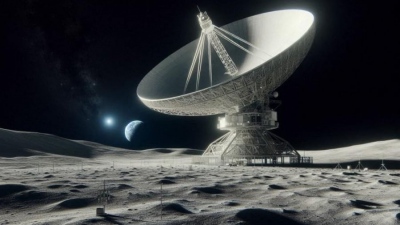
Scientists at the Search for Extraterrestrial Intelligence (SETI) program have presented a radically new strategy that could change the way we search for our "intellectual siblings." Instead of tuning telescopes to narrow radio frequencies in the hope of detecting a specific "hello," researchers propose analyzing the vast amounts of broadband data already collected from ordinary astronomical observations. This approach is based on the assumption that an advanced technological civilization wishing to make its presence known would not limit itself to a simple radio signal. Its presence in space could manifest through powerful energy emissions, which for years we may have dismissed as natural noise or cosmic background radiation. Perhaps signs of technology have already been detected by our instruments but remain hidden within "dirty" data that require new algorithms to be deciphered!
Broadband search instead of narrow frequencies
Traditionally, SETI searched for a "needle in a haystack": a specific signal at the hydrogen frequency (1420 MHz), assuming it would serve as a universal "beacon." However, the new strategy argues that the communication systems of extraterrestrial civilizations could use ultra-broadband frequencies. This is energy-efficient and allows for the transmission of massive amounts of data. If we only search within a narrow spectrum of frequencies, we are essentially missing a large part of the picture. Modern datasets collected by telescopes like the Hubble contain terabytes of information about distant galaxies and stars. Scientists believe that by applying special filters to this data, anomalies can be identified that are not explained by natural phenomena such as pulsars or quasars. "The transition from searching for narrow signals to analyzing broadband noise is like moving from listening to a single radio station to monitoring all internet traffic. We are not just looking for sound, but for traces of informational activity," explained physicist Dmitry Lapshin.
Algorithms instead of telescopes
The new method relies primarily on software rather than hardware. Instead of building new radio telescopes, scientists propose leveraging artificial intelligence to analyze vast data archives. This is a form of "digital archaeology," where instead of ancient artifacts, correlations are sought within the electromagnetic background of the universe. Just as secrets beneath the Antarctic ice require detailed analysis of satellite imagery, potential alien signals require the analysis of complex waveforms. Applying this strategy to existing data archives from NASA and Arxiv.org may reveal traces of technology in places where no one has looked for them until now.
Why signals might be everywhere
The human presence on Earth has already left traces beyond the planet. Our radio waves and city lights create a "techno-signature." Scientists believe that extraterrestrial civilizations likely go through similar stages of evolution. If they have learned to fully harness the energy of their stars, their energetic footprints could be visible from vast distances. "Every complex system leaves traces. In biology, these are microbes surviving in the absolute darkness of caves; in space, they are anomalous energy emissions that are not explained by the thermodynamics of stars," noted biologist Andrei Voroshilov.
Problems and interference
One of the biggest problems remains human noise. The massive number of telecommunications satellites and terrestrial transmitters creates interference that can easily be mistaken for alien signals. Scientists must learn to distinguish "digital junk" from a potential real message. Additionally, there is the risk of misinterpreting natural phenomena. In the history of science, there are many cases where pulsars or even reflections of Earth's signals from the ionosphere were considered extraterrestrial signals. The new strategy includes multi-layered verification to avoid such errors.
From radio waves to the chemistry of life
The search for life is not just about the physics of signals but also the chemistry of environments. Before a civilization can send a radio signal, it must first emerge and evolve. For this reason, SETI is increasingly collaborating with biologists. Scientists are looking for universal ways to distinguish the living from the non-living, for example, by studying the properties of amino acids in meteorites. "We are looking for traces of life in all its forms: from techno-signatures in the radio spectrum to bio-signatures on other planets. Organic life can exist under incredible pressures and reach levels of complexity that allow for the development of technology," noted anthropologist Artem Klimov.
www.bankingnews.gr











Σχόλια αναγνωστών